
Fan Coil Thermostats and Control Panels
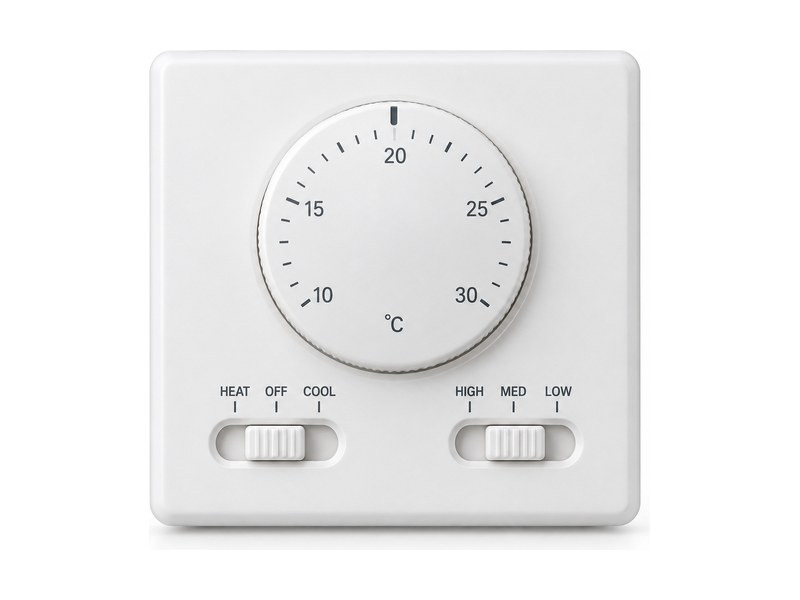
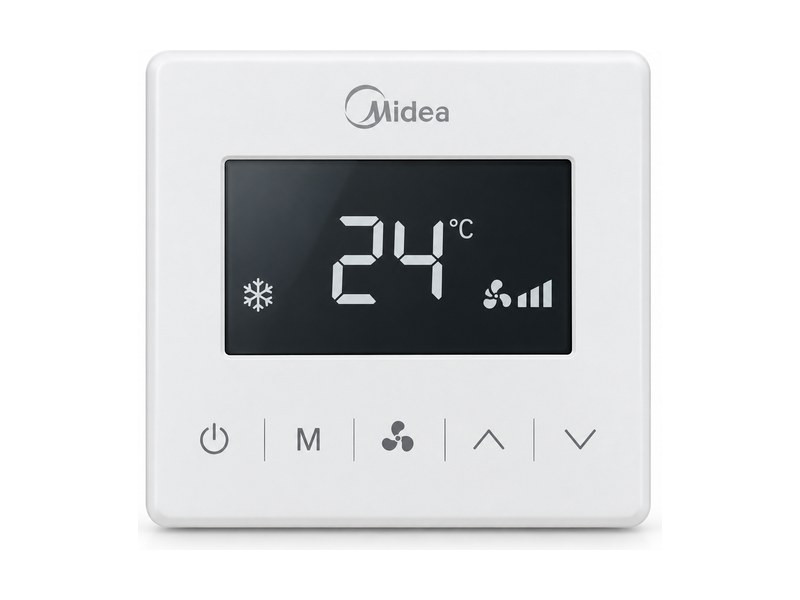

A fan coil thermostat measures room temperature and controls the unit fan, operating command and water valve in response to the selected setpoint. As the main interface between the occupant and the fan coil, the controller has a direct effect on comfort and correct system operation. Available solutions range from straightforward mechanical thermostats to digital panels that can communicate with a building-management system.
In a 2-pipe installation the thermostat controls one valve circuit for seasonal cooling or heating. A 4-pipe arrangement may require separate control of chilled-water and hot-water valves. Selection should therefore not be based on panel appearance alone. Compatibility with the 2-pipe or 4-pipe scheme, fan-motor control type, speed stages, valve voltage and power supply must be checked against the technical wiring documentation.
The KJR-18B/E is a mechanical control option intended for compatible 2-pipe and 4-pipe ducted fan coils. The KJRP-86I/MFK-E is used with compatible floor-standing and ducted units. KJRP-86A/BMFNKD-E supports suitable 2-pipe and 4-pipe fan coils and includes Modbus communication capability. Modbus operation also depends on correct addressing, communication parameters and support from the connected fan coil and building-management system.
Controller position affects temperature measurement. It should not be installed in direct sunlight, in the discharge-air path, beside a doorway, next to a heat source or on an unusually cold external-wall section. Signal and power wiring must follow the manufacturer diagram, while valve outputs and fan-speed commands should be tested during commissioning. Incorrect wiring can cause unstable temperature control or damage to connected equipment.
Before selecting a controller, identify the electrical diagram, pipe arrangement and control protocol of the relevant fan coil unit. Other equipment for central climate control and building systems is available under cooling and ventilation systems. Controllers with a similar appearance are not necessarily electrically or functionally interchangeable.